Great Lakes Association of Science Ships
User:   Pass:   
Not registered? Register Now!   

» News & Events

You must be logged in to add a new Article.
Pages:  

1


13th Science Vessel Coordination Workshop


Posted by burrowsm under Conferences on 2008-11-22

The 13th annual Science Vessel Coordination Workshop will be held on January 15, 2009 in Great Lakes room 112 at the Great Lakes Maritime Academy.  The GLASS steering committee is planning on a full day program that will run concurrently with a portion of Industry Days in Traverse City, Michigan.  Industry Days runs from January 14-16, 2009 at the Holiday Inn West Bay.  Since the venues are right next to each other, attendees will have a choice of topics to hear and discuss.  A draft agenda has been developed and will be posted on this website next week.  Please make plans to attend both the science vessel coordination workshop and Industry Days!


13th Annual Science Vessel Coordination Workshop to be Held January 15, 2009


Posted by burrowsm under Latest News on 2008-11-20

The 13th annual Science Vessel Coordination Workshop will be held on January 15, 2009 in Great Lakes room 112 at the Great Lakes Maritime Academy.  The GLASS steering committee is planning on a full day program that will run concurrently with a portion of Industry Days in Traverse City, Michigan.  Industry Days runs from January 14-16, 2009 at the Holiday Inn West Bay.  Since the venues are right next to each other, attendees will have a choice of topics to hear and discuss.  A draft agenda has been developed and will be posted on this website next week.  Please make plans to attend both the science vessel coordination workshop and Industry Days!


House Urges New Tug Rules


Posted by burrowsm under Latest News on 2008-09-19

House Urges New Tug Rules


--- When Rear Adm. James Watson IV promised Rep. Elijah Cummings, D-Md., at a hearing Tuesday that the Coast Guard would issue proposed rules regulating tugboats in 2009, Cummings asked Watson to repeat the pledge.
The frustration with the long-delayed new rules on tugs gained new urgency this summer when an oil spill in the Mississippi River shut down shipping through New Orleans. The spill has been blamed on a tugboat being operated by a company that was involved in another accident on the river 10 days earlier.

It's been four year since Congress ordered the Coast Guard to create rules requiring the regular inspection of towing vessels and setting limits on the number of hours that crew members work each day. Neither set of rules has been issued

As the Coast Guard's mission has been expanded in the age of homeland security, it appears that tugboat safety is not foremost on the agenda.

On July 23, the tugboat Mel Oliver, pushing the fuel barge DM 932, crossed in front of and collided with the 600-foot motor tanker Tintomara. Nearly 300,000 gallons of oil spilled from the barge.

It was determined that the Mel Oliver was under the control of a steersman apprentice, whose license did not authorize him to operate the vessel without the captain being in the wheelhouse. The captain was not on board at the time of the accident.

The Coast Guard held two days of hearings on the accident in New Orleans in mid-August, and Watson said the hearings will resume Oct. 9 with about 30 more witnesses.

In May, the American Waterways Operators, found DRD wanting on its safety audit. At the hearing, Thomas Allegretti, president and CEO of the association, said that with Coast Guard regulations in place, that information might have been disseminated in a way, and with some consequences, that might have made a difference.  

During the hearing both Cummings and the ranking Republican on the subcommittee, Rep. Steve LaTourette of Ohio, said those responsible for the accident leading to the oil spill should face jail time.

 Source: Times Picayune, September 18, 2008


NOAA 4-Year Vessel Acqusition Plan


Posted by burrowsm under Latest News on 2008-08-11

The speed and reliability of two new survey launches carried by the NOAA hydrographic survey ship Rainier have improved overall survey efficiency and safety levels, according to NOAA’s Office of Marine and Aviation Operations.

NOAA received the second of two identical launches built by All American Marine of Bellingham, Wash., earlier this year. The new 28-ft. aluminum-hulled boats replaced launches that were in service for more than 30 years conducting hydrographic survey operations along the Alaskan and West coasts.

The new launches can travel at speeds up to 26 knots, more than twice the speed of the vessels they replaced, drastically reducing the travel time to the work grounds. Their improved reliability has greatly reduced mechanical and electrical downtime while updated electronics and new multibeam sonar systems acquire data at nearly twice the density of the older systems. Additionally the launches are more comfortable for the personnel operating the vessels.

The design of the new launch is based on an evolution of the original hull form designed for NOAA in 1975 and was updated by Jensen Maritime Architects. This proven design features sturdy construction and a full keel for survey work in poorly charted waters. Design updates include an open working deck and 200 lb. capacity A-frame that can mount a wide variety of equipment.

The propulsion package consists of a Cummins QSC 8.3 liter 490-hp engine turning a 25”x26” ZF propeller through a ZF 305 gear. Cruising speed is 24 knots and typical survey speeds are approximately eight knots.

The multi-mission designed boats are equipped with a state-of-the-art hydrographic surveying suite, including dual frequency Reson 7125 multibeam sonar, Applanix POS MV positioning and attitude sensor, and a Brooke Ocean MVP-30 moving vessel profiler. NOAA installed and integrated the survey systems before putting both boats into operational use.

NOAA intends to replace the aging fleet of survey launches with six to eight additional vessels purchased over the next four years.

Ref: Marine Technology Reporter 08/06/2008


Warning ! - Defective Flare Guns!


Posted by burrowsm under Latest News on 2007-10-18

We probably ALL use this product on our vessels and it could be a serious issue. IF you encounter a problem with one of these guns, please notify me. We probably have thousands of the guns out there!

Please pass this along to your Operators in the field,

IMMEDIATELY! WARNING: Some Flare Guns Can't Be Opened!  Some of the plastic flare guns made by OLIN (now ORION) can't be opened wide enough to accept a flare cartridge and would therefore be useless in an emergency. Ted Swanson, a marine surveyor in Florida, regularly checks flare guns while conducting surveys and found that 13% of the OLIN guns (9 out of 69) he has inspected can't be fully opened.  A spokesman at ORION Safety Products confirmed the problem; nylon material used to keep the breech closed can deform and jam the opening mechanism. Any OLIN plastic flaregun is suspect, as are ORION guns made before 2000, the year the mechanism was re-engineered (guns with the modification have the USCG approval code 160 028/12/1 stamped on the body). A recall has not been issued, although ORION has agreed to replace any of the defective guns, regardless of age. ORION recommends checking the operation of the guns now and at the beginning of every season; if the breech won't open, the gun should be sent back for replacement.  Send defective guns to : ORION Safety Products, Marine Division, 3157 N. 500 West, Peru, IN 46970

Gary L. Hill, Bureau Watercraft Safety Program Manager USCG,
e-mail: gary_l_hill@usgs.gov\r\n


NOAA Research Vessels go on a Vegetarian Diet


Posted by burrowsm under Latest News on 2006-04-24

Article featured in MarineLink.com on April 24, 2006: "NOAA Research Vessel on Vegetarian Diet" Monday, April 24, 2006 in The Huron Explorer.

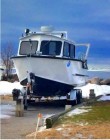
A 41-ft. former Coast Guard vessel now serving on the Great Lakes is the first modern U.S. research vessel to operate free of petroleum products. Photo credit: NOAA. A National Oceanic and Atmospheric Administration (NOAA) small research vessel is now powered by soybeans. The Huron Explorer, a 41-ft. former Coast Guard vessel now serving on the Great Lakes, is the first U.S. research vessel to operate free of petroleum products. The vessel was given an award by the Department of Energy's Federal Energy Management Program during an Earth Day Week event on the shores of Lake Michigan. "NOAA has a commitment to stewardship of the environment, and this research vessel, the R/V Huron Explorer, demonstrates that commitment in very practical ways. Environmentally friendly vessels are better suited to tread lightly on the ecosystems they help research," said Stephen B. Brandt, NOAA acting deputy assistant administrator for oceanic and atmospheric research. The "You Have the Power" campaign helps federal agencies reach their energy-saving goals by raising awareness about energy efficiency at federal facilities. The federal government can encourage wise energy use, while simultaneously protecting the environment and conserving natural resources. In 2004, the Huron Explorer, a 41-foot former U.S. Coast Guard vessel, joined the fleet of the NOAA Great Lakes Environmental Research Laboratory's other two ships that are used to conduct research on the Great Lakes. The Huron Explorer serves the NOAA Thunder Bay National Marine Sanctuary and Underwater Preserve in Lake Huron. The other two ships, including the 67-foot Shenehon, which is one of the oldest in the NOAA fleet, use some non-petroleum products. The Shenehon began its use of B100 biodiesel in 2000 and was dubbed the "french fry" ship by some. It showed immediate reductions in visible emissions, smoke and offensive odor, with unchanged performance of the main engine or generators. The use of B100 was a significant achievement in demonstrating soy oil as an alternative fuel in marine applications. B20, a 20 percent blend of soy oil with petroleum diesel, has been in use for a number of years in road vehicles, such as cars, buses and trucks. GLERL's Ship Operations Group, headed by Dennis Donahue, expanded the use of bio-hydraulic oil on the Laurentian, an 80-foot research vessel built in 1974. All systems using the bio-hydraulic oil performed satisfactorily without change to pump or equipment performance while contributing to improved onboard storage and reduced inventory. In August 2005, the Huron Explorer completed its transformation from petroleum products to biofuels and lubricants by incorporating rapeseed-based hydraulic oil for its deck crane, winches, transmission and steering gear, and 100 percent soy biodiesel for engine fuel and canola-based motor oil. "We saw dramatic reductions in emissions and improvements to the original 1974 engines in wet exhaust odor and pollution, " Donahue said. "The biodegradable vegetable oils offer an additional level of environmental protection in case of a spill or leak." Donahue added that the switch to agri-products has improved the work environment of the ships' crews and scientists. "These ships have become real-world field studies that can be used to expand field test data and support other ship conversions," said Donahue. Other NOAA boat operations and some private vessels are implementing similar bio-product conversions based upon experiences at GLERL. GLERL plans to convert the Shenehon's remaining systems to agri-products this year and the Laurentian is slated to convert to B100 biodiesel in 2007, making all three of the ships 100 percent petroleum-free.

Pages:  

1


This web site and all of its contents are © Copyright 2006-2008 International Joint Commission